Gold Investment
Stay informed on gold investment trends, inflation risks, and market analysis. Learn expert strategies for smarter gold investing.
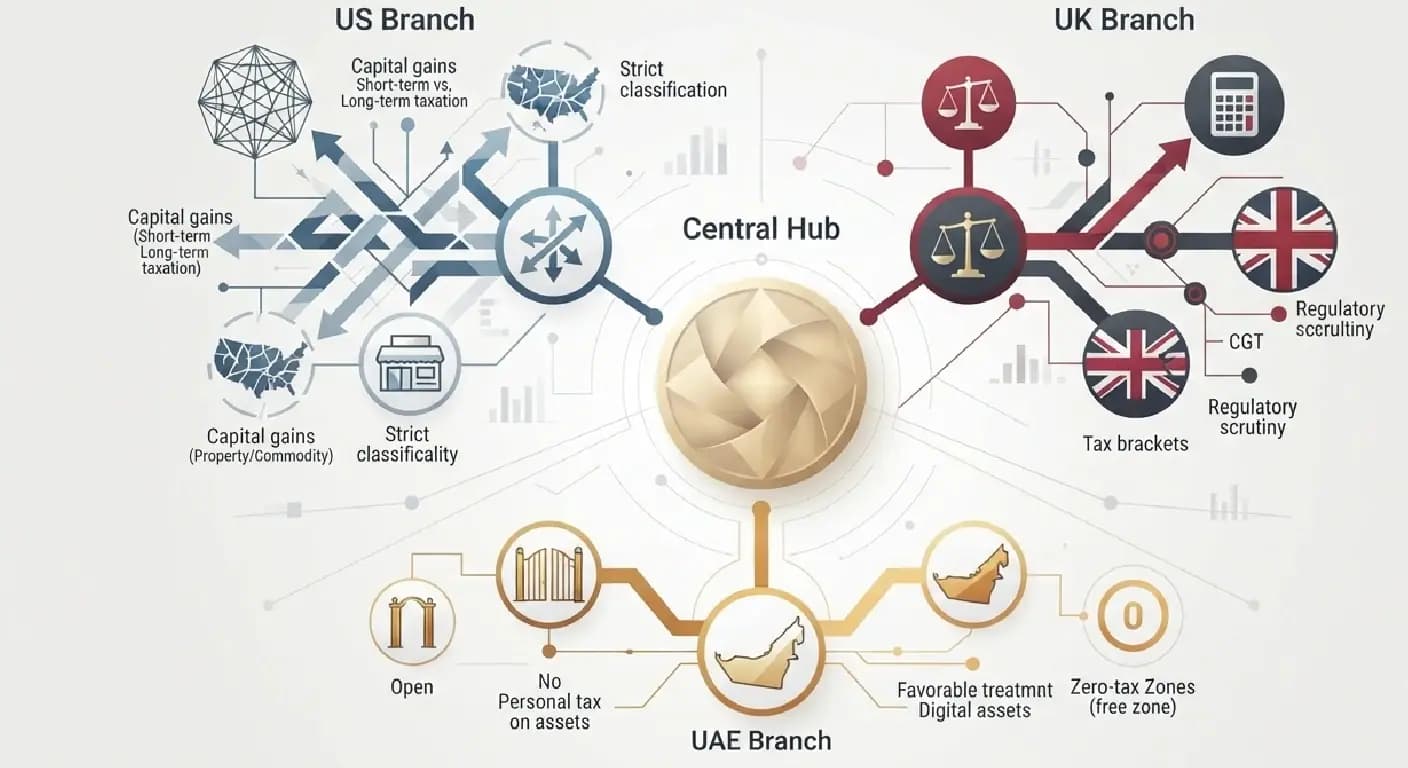
How the US, UK, and UAE Actually Tax Gold-Backed Tokens
Quick answer: In the United States, tokenized gold is taxed as a digital asset (capital gains under Form 8949), though a conservative filer may apply the 28% collectible rate if the token is redeemable for physical bullion. In the United Kingdom, HMRC taxes it as a cryptoasset under Capital Gains Tax, with the token's tax situs following the location of the underlying gold. In the UAE, individuals pay 0% personal capital gains tax on tokenized gold, though business-level activity can trigger 9% corporate tax

Tokenized Gold Market Size 2026: $90.7B Record Quarter
The tokenized gold market experienced a structural "step-function" acceleration in Q1 2026, with spot trading volume reaching $90.7 billion—surpassing the total for the entire year of 2025 in just 90 days. This surge was primarily driven by record-high gold prices acting as a catalyst, alongside increased institutional participation and the emergence of new, programmable yield-bearing products that differentiate tokenized gold from traditional ETFs. While the market shows signs of maturity with higher correlation to traditional price discovery, it remains heavily concentrated, with XAUT and PAXG accounting for approximately 89.1% of commodity tokenization growth.
Tokenized Gold vs Physical Gold
In 2026, the main distinction between tokenized gold and physical gold lies in the associated risks and trade-offs. Physical gold has no counterparty risk and is widely recognized but comes with a 28% US collectibles tax, annual storage fees of 0.5–1.0%, and cross-border issues. Tokenized gold (primarily PAXG and XAUT, making up over 96% of the $6 billion market) trades 24/7, settles quickly, costs 0.15–0.25% annually to hold, and can yield 2–10% APY in DeFi, but relies on issuer and regulatory trust. The tokenized gold market reached $90.7 billion in Q1 2026, boosted by institutional interest and better infrastructure. A balanced investment strategy includes 5–15% physical gold for hedging and tokenized gold for liquidity and yield, with regulated platforms like GoldOn offering Shariah-compliant options for MENA investors.

Tokenized Gold & DeFi: How to Earn Yield on Gold-Backed Tokens
Tokenized gold bridges the gap between traditional store-of-value assets and decentralized finance (DeFi), enabling yields on previously static metal holdings. Investors can leverage five primary mechanics, AMM liquidity provision, lending protocols, yield aggregators, gauge voting, and gold-collateralized borrowingto generate annualized returns ranging from 1% to over 15%. However, success requires navigating a complex, layered risk architecture, including smart contract vulnerabilities, oracle manipulation, and potential liquidation in collateralized models. As regulatory frameworks like MiCA and regional standards evolve, the transition from passive gold ownership to productive, yield-bearing tokenized gold represents a fundamental shift in portfolio management for the modern investor.

Digital Gold Investment Guide
Tokenized gold is a major new development in gold investment since the launch of ETFs in 2003. It allows people to own physical gold through blockchain technology, enabling quick transactions and around-the-clock access. Unlike traditional paper claims, tokenized gold offers clear proof of reserves, providing trustworthy information. This makes it an important tool for modern investors dealing with current global and currency uncertainties.

How to Invest in Gold?
Investing in gold in 2026 offers diverse methods to hedge against inflation and protect wealth, ranging from traditional physical bars to modern, liquid tokenized gold and ETFs. Because gold provides stability rather than high growth, it is best used as a portfolio diversifier, typically 5% to 15% of your total assets, to reduce risk during economic uncertainty. Choosing the right method depends on your budget and custody preferences, but always prioritize regulated platforms with audited, transparent gold reserves to ensure security.