What Is Tokenized Gold?

Disclaimer: For informational purposes only. Not financial or investment advice. Data sourced from publicly available research as of June 2026.
You can now own a verified slice of a gold bar in a Swiss vault without leaving your phone. Here's the plain-language breakdown of how that actually works and what to check before you trust any platform with your money.
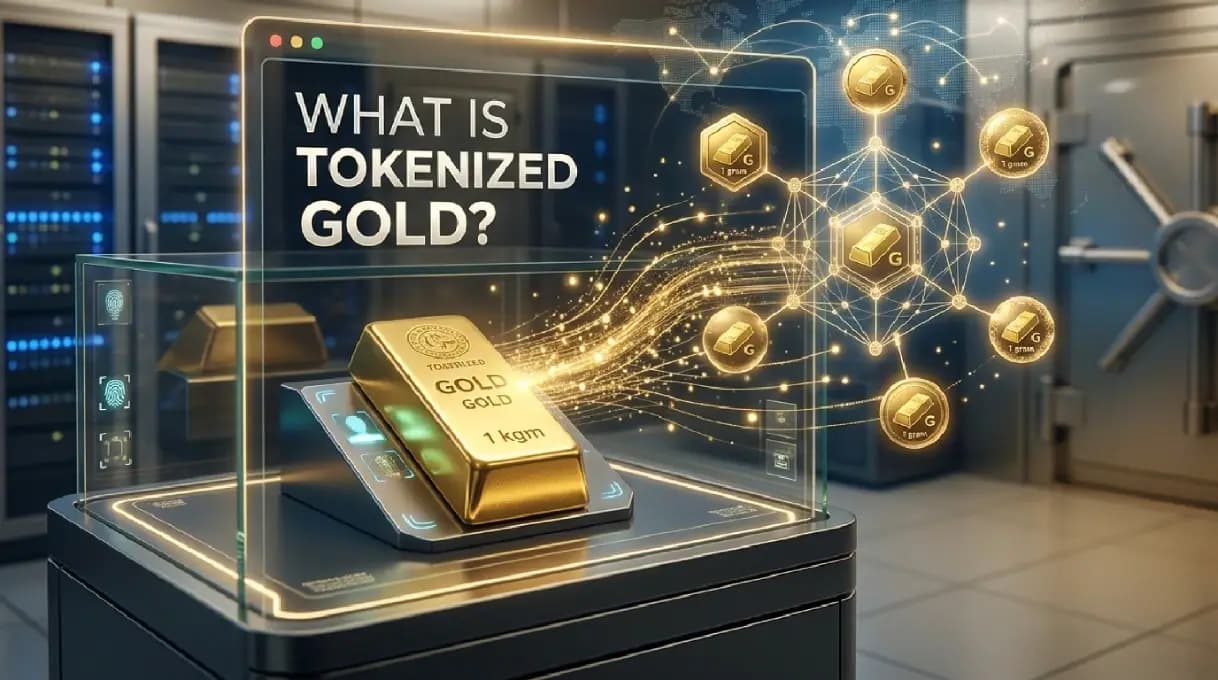
Quick answer: Tokenized gold is a digital token on a blockchain that gives you direct legal ownership of physical gold sitting in a professional vault. When you buy one token, you own a specific, weighed quantity of real metal, not a share in a fund, not a futures contract, not a promise. The token is your proof of ownership. It lives in your wallet, trades around the clock, and can be redeemed for the actual gold if you ever want it
Let's Start With What Tokenized Gold Actually Is
Most explanations of tokenized gold make it sound more complicated than it needs to be. Here's the short version:
A company buys real gold bars. It puts them in a vault. Then it issues digital tokens; one token for every troy ounce, or sometimes every gram, of gold it just locked away. You buy those tokens. Now you own gold.
That's it. The rest, the blockchain, the smart contracts, the oracle feeds, is the infrastructure that makes the ownership verifiable and the token transferable. The underlying idea is as old as a warehouse receipt.
What's new is what the technology adds on top of that basic structure:
- You can split a single troy ounce into one million pieces and buy just the slice you can afford
- You can send it to anyone in the world in under a minute , no broker, no bank, no working hours required
- The total supply of tokens and the total weight of gold in the vault are publicly auditable at any time; you don't have to take anyone's word for it
- You can use it as collateral, earn yield on it, or plug it into financial protocols that didn't exist five years ago
None of those four things is true of a gold ETF. None are true of a futures contract. That's the gap tokenized gold fills.
The Moment Traditional Finance Proved the Point
On January 29, 2026, something happened that no one in traditional finance could ignore.
Hang Seng Investment Management launched a physically backed gold ETF on the Hong Kong Stock Exchange (ticker: 03170.HK). Nothing unusual there. What was unusual was what they bolted on: a tokenized share class issued on Ethereum.
HSBC served as both custodian for the physical gold and tokenization agent for the digital units. The gold sits in designated vaults in Hong Kong. The tokenized units sit on a public blockchain. The fund gained roughly 9% in its first day of trading as gold simultaneously hit a fresh record near $5,600 per ounce.
Why does this matter to you? Because when a 130-year-old bank like HSBC agrees to be the tokenization agent for a product traded on a regulated stock exchange, the question Is tokenized gold legitimate?' is already answered. The real question now is: which tokenized gold product is right for you?
That's what the rest of this guide answers.
Once you've verified points and you're ready to act, our full guide to investing in gold walks you through every method side by side, from physical bullion to tokenized products, so you can match the right vehicle to your budget and goals.
How Your Gold Actually Gets Onto the Blockchain
You don't need to understand blockchain technology to own tokenized gold, any more than you need to understand SWIFT to do a bank transfer. But knowing the basics protects you from platforms that use the language of tokenized gold without delivering the substance.
Step 1: Real gold enters a real vault
The issuer buys certified gold bars and deposits them with an independent custodian, a vault operator with no financial relationship to the issuer. The custodian records each bar's serial number, weight, and purity. From this moment, that gold is legally ring-fenced from the issuer's own assets.
Why it matters: If the issuer company went bankrupt tomorrow, those bars couldn't be seized by creditors. They belong to token holders.
Step 2: A smart contract creates your token
Once the custodian confirms the gold is in place, the issuer's smart contract, a program deployed on the blockchain that runs automatically and can't be edited retroactively, mints new tokens equal to the weight of gold received. One troy ounce in the vault means exactly one new token in circulation. No more.
The same contract destroys (burns) tokens whenever someone redeems for physical gold. The supply always matches the vault. Anyone can check this in real time by reading the contract's public data.
Step 3: An auditor confirms the match
Periodically, monthly for the best platforms, an independent accounting firm physically inspects vault holdings and publishes a signed attestation: 'We counted X bars weighing Y ounces. There are Y tokens in circulation. The numbers match.' That report goes public.
The platforms worth your attention name their auditor upfront. Paxos uses Withum (monthly). Tether Gold uses BDO Italia (quarterly ISAE 3000 standard). Kinesis uses Bureau Veritas. If a platform won't name theirs, don't continue.
Step 4: You buy on an exchange or platform
You purchase tokens on a crypto exchange (Binance, Kraken, Coinbase) or a specialist platform like GoldOn. The tokens land in your wallet, whether that's a platform custody account or your own personal wallet, and from that moment, you are a gold owner.
What Do You Actually Own? A Straight Comparison
Here's the question that clears up most of the confusion around gold products. Not 'how do they work?' but 'what do I legally own?'
| Gold Product | What you own | Physical gold in your name? | Can you get the gold out? | Tradeable at 3am on a Sunday? |
|---|---|---|---|---|
| Physical coin/bar | The metal itself | Yes | Yes, you already have it | No |
| Gold ETF (e.g. 03170.HK, GLD) | Shares in a fund | No, the fund holds it | No (cash redemption only for retail) | No (stock exchange hours) |
| Gold futures | A contract to buy/sell at a price | No | Rare cash-settled exceptions only | Via CME Globex only |
| Tokenized gold (PAXG/XAUT) | A legal claim on specific vaulted bars | Yes: by serial number | Yes (min. quantities apply) | Yes, blockchain never closes |
| GoldOn token | A legal claim on DMCC-vaulted gold in Dubai | Yes: VARA-governed | Yes, gram-based minimums | Yes, 24/7 on supported chains |
Source: Product terms as of June 2026. GLD = SPDR Gold Shares. 03170.HK = Hang Seng Gold ETF.
The ETF row might surprise you. When you own shares in GLD or the new Hang Seng ETF, you do not own gold. You own a financial instrument that tracks gold's price. The fund owns the gold. Your recourse, if something went wrong, is against the fund's trustee, not against a specific bar in a specific vault with your name on it.
Tokenized gold flips this. The serial-numbered bar is yours. The fund, the trustee, the intermediary, none of those are in the chain between you and the metal.
If you want to understand why 2026 is the year this shift became impossible to ignore, and what the structural forces behind gold's record prices mean for investors, read [The Case for Digital Gold Investment in 2026]
What Does Tokenized Gold Actually Cost? The Fee Breakdown Nobody Shows You
Most tokenized gold platforms lead with a 0% storage fee. That number is accurate, and also incomplete. Here are all the costs you might encounter, with real figures:
Creation fee (buying directly from the issuer)
Paxos (PAXG): 0.15% creation fee + 0.02% on-chain transaction fee collected at smart contract level. On a $5,000 purchase, that's roughly $8.50 total.
Tether Gold (XAUT): ~0.25% creation fee. On a $5,000 purchase, that's $12.50.
Exchange spread (buying on secondary markets)
When you buy on an exchange rather than directly from the issuer, you pay the bid-ask spread plus any exchange trading fee. In calm conditions: 0.1%–0.4%. During the February 2026 gold market spike, some exchange spreads widened past 1.5% for several hours. If you're buying during a fast-moving gold market, this is the cost to watch.
Annual storage fee
For most major tokenized gold products in 2026: zero. Paxos confirmed this as policy. Tether Gold charges no ongoing custody fee. This is a genuine advantage over physical vault storage (which costs 0.5–1% annually) and some gold ETFs.
Redemption minimums: the hidden floor
This is where smaller investors need to pay attention:
- PAXG: Minimum 1 fine troy ounce (~$4,500–$5,000) for physical delivery in London
- XAUT: Minimum 50 tokens (~$160,000 at March 2026 prices) for Swiss vault delivery, below that, your only exit is selling on secondary markets
- Gram-denominated platforms like GoldOn set far lower redemption thresholds, making physical delivery a realistic option for investors accumulating smaller amounts over time
The Hang Seng ETF comparison point
For context: the Hang Seng Gold ETF (03170.HK) launched with a 0.25% annual management fee and a 0.4% total expense ratio, which is competitive for a traditional ETF but still an ongoing annual charge that tokenized gold products generally don't have.
Over a five-year hold on $20,000, that 0.4% TER costs you roughly $400. A tokenized gold product with zero storage fees costs you nothing on that same holding, except for the one-time entry spread.
Gold That Actually Earns: The New Yield Layer
Here's something that wasn't true 18 months ago: you can now earn yield on your gold without selling it, lending it yourself, or using a synthetic product.
The GOLD -2.3% annual yield on allocated gold
In January 2026, a DeFi infrastructure firm called Theo launched GOLD, the first tokenized gold product built primarily to generate income. It targets a 2.3% annual yield generated through institutional lending against the physical collateral, not through algorithmic mechanisms.
The GOLD is available on Hyperliquid, Uniswap, Morpho, and Pendle. You can use it as collateral or deposit it into yield strategies. Theo's earlier product, thBILL (tokenized US Treasuries), hit $200M in TVL within four months of launch, giving you a sense of the institutional appetite in this category.
Scudo- gold as actual spending money
Also in January 2026, Tether launched Scudoa, a sub-unit of XAUT specifically designed to make gold usable at a transaction scale. Rather than moving full Troy ounces, Scudo allows gold transfers at everyday denominations. Tether became the first publicly listed gold company to offer dividends paid in tokenized gold.
For you as an investor, Scudo doesn't change your ownership of XAUT. What it signals is the direction of travel: the infrastructure for gold-as-payment is being built alongside gold-as-savings. A gram of gold you hold today could, within a few years, be the same instrument you use to pay for something.
Gold is no longer just something you hold and wait. In 2026, it can earn yield, serve as DeFi collateral, or function as a unit of account for transactions, features that don't exist in any ETF or futures product. You still don't have to use any of these features. But they're available if your strategy calls for them.
What Can Go Wrong: The Honest Risk List
Tokenized gold is genuinely safer than most crypto assets. That doesn't mean it's risk-free. Here's what you actually need to know:
Smart contract risk
The token's rules live in code. Code can have bugs. If the contract has a vulnerability, it could theoretically be exploited. The mitigation is independent security audits by firms such as CertiK, Trail of Bits, or OpenZeppelin before the contract goes live, and re-audits when contracts are updated. PAXG's contract has no confirmed exploits since September 2019. But zero past exploits doesn't mean zero future risk.
Issuer freeze risk
Most tokenized gold contracts include an administrative function that lets the issuer freeze specific wallets, typically used to enforce sanctions. This means your tokens can technically be frozen by the issuer under certain conditions. If absolute, uncensorable ownership is your priority, physical gold held personally is the only product that delivers it. Tokenized gold, like a bank account, exists within a regulatory framework that includes compliance tools.
Redemption threshold risk
If you hold less than the minimum redemption quantity and the issuer platform shuts down, your path to the physical metal becomes complicated. This is why redemption minimums matter so much when you're comparing platforms. Check them before buying.
Oracle manipulation risk
A smart contract can only act on information it receives. The system that feeds vault data to the contract is called an oracle. If that feed is compromised or manipulated, the contract could mint incorrect quantities. Platforms that use decentralized oracle networks (such as Chainlink) reduce this risk by sourcing data from multiple independent feeds.
Price spread risk in fast markets
During the February 2026 gold price spike, spreads between tokenized gold prices and spot gold widened temporarily. This isn't a fundamental risk; it's a liquidity microstructure effect. But if you're trading in and out of positions during volatile markets, the entry/exit cost can be higher than expected.
What doesn't go wrong: the gold itself
Here's what's not a risk: the physical metal disappearing. With properly structured, allocated custody, the gold bars don't belong to the issuer. They can't be used by the issuer to fund operations, can't be seized by creditors in bankruptcy, and don't move unless you redeem them or the custodian is independently instructed to release them. The risk of metal loss, the vault burning down, and the custodian committing fraud is real but extremely low for major institutional custodians with full insurance coverage.
About GoldOn
GoldOn is a tokenized gold platform built for GCC investors who want gram-denominated access to physically allocated gold under local regulatory oversight.
The underlying gold is held in DMCC-certified vaulting, one of the world's largest physical gold trading hubs.
Sources & Further Reading
→ The Block: Hang Seng Gold ETF Launch - 03170.HK, HSBC tokenization agent, Jan 29 2026
→ TradingKey: Tokenized Gold vs. Traditional Markets - Q4 2025 volume analysis
→ Yellow.com: Tokenized Gold vs. Dollar Stablecoins -ETF AUM data, honest competitive analysis
→ World Gold Council: Gold Demand Trends 2025 - central bank purchase data
→ The Block: Theo thGOLD Launch - 2.3% yield, Jan 2026
 Toofan Shaterloo
Building tokenised gold infrastructure for a multipolar world. Board: @HectocornGroup. Prev: Netcore, Dengage. Operator → $300M–$1B. 1x exit. Top 100 UK Tech Influencer. Gold is the hedge.
Related posts
All posts
Toofan ShaterlooMay 28, 2026
How to Invest in Gold?
Investing in gold in 2026 offers diverse methods to hedge against inflation and protect wealth, ranging from traditional physical bars to modern, liquid tokenized gold and ETFs. Because gold provides stability rather than high growth, it is best used as a portfolio diversifier, typically 5% to 15% of your total assets, to reduce risk during economic uncertainty. Choosing the right method depends on your budget and custody preferences, but always prioritize regulated platforms with audited, transparent gold reserves to ensure security.

Toofan ShaterlooJun 1, 2026
Digital Gold Investment Guide
Tokenized gold is a major new development in gold investment since the launch of ETFs in 2003. It allows people to own physical gold through blockchain technology, enabling quick transactions and around-the-clock access. Unlike traditional paper claims, tokenized gold offers clear proof of reserves, providing trustworthy information. This makes it an important tool for modern investors dealing with current global and currency uncertainties.
Toofan ShaterlooJun 8, 2026
How To Buy Tokenized Gold Online?
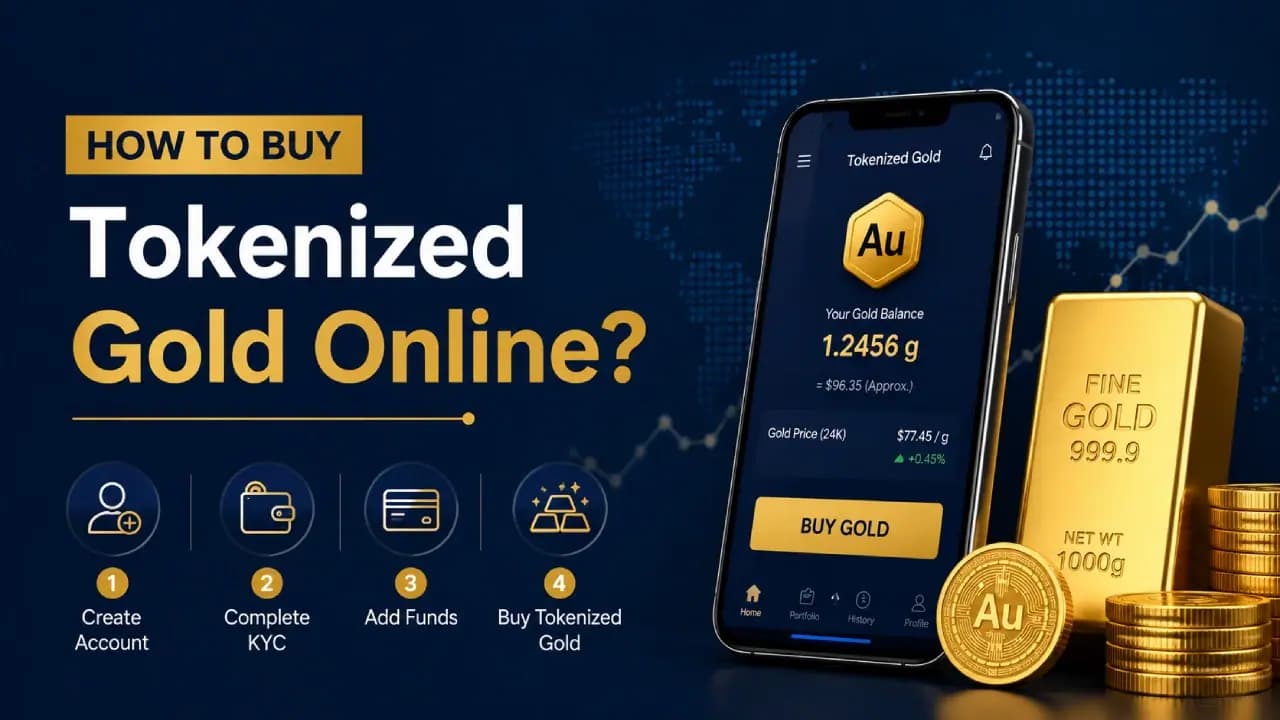
To buy tokenized gold online: choose a regulated platform (PAXG, XAUT, or a gram-based provider like GoldOn) → create an account → complete KYC → fund via bank transfer or card → buy in any amount from under $10. Each token represents real, vaulted gold with instant settlement and 24/7 trading , at a fraction of the cost of physical gold or ETFs.