Is Tokenized Gold Safe?Risks, Audits, and What to Check in 2026

What Does Safe Even Mean for Tokenized Gold? When people search for a tokenized gold safe, they are usually asking one of five different questions without realizing it:
- Is the physical gold real? (Vault and audit risk)
- Could the issuer steal or lose my gold? (Counterparty and insolvency risk)
- Can the smart contract be hacked? (Technical/blockchain risk)
- What happens if I lose my private keys? (Custody risk)
- Is it legal in my country? (Regulatory risk)
I answered all five, with 2026 data, not marketing language. The short version: the gold itself is almost never the risk. What most investors underestimate is the legal structure governing your relationship with that gold. As Reuters reported in February 2026, quoting Duke University finance professor Campbell Harvey: Anytime you have got a custodial arrangement like this, it is challenging" (Reuters, Feb 3 2026).
DISCLAIMER
This article is for informational and educational purposes only and does not constitute financial, legal, tax, investment, or Shariah advice. All citations are from publicly available sources from 2026. Platform regulatory status and audit schedules are subject to change; always verify directly with the issuer before investing. Past performance of gold prices does not guarantee future results. Tokenized gold involves risk, including potential loss of capital.
Risk1: Is the Physical Gold Actually There?
How Vault Backing Works? Every legitimate tokenized gold product follows the same core model: physical gold is purchased, stored in an audited vault, and then one token is minted per troy ounce of gold. When tokens are redeemed or burned, the matching gold leaves the vault. The gold supply and token supply are meant to match 1:1 at all times.
The key distinction is allocated vs unallocated gold:
- Allocated gold: Specific, serial-numbered bars that belong to YOU. If the issuer goes bankrupt, these bars are legally not part of the issuer's estate. Think of it like your personal safe deposit box at a bank; even if the bank fails, the contents are yours.
- Unallocated gold: A general claim on a shared pool. You are an unsecured creditor. If the issuer fails, you may get pennies on the dollar. This is how most bank gold accounts work and why the fee is zero, but the risk is higher than people assume.
- The rule: Always confirm a product uses allocated, segregated, serial-numbered gold before investing. Any platform that says 'we hold gold on your behalf' without specifying this structure is using unallocated holding.
How Proof-of-Reserves Attestations Work and Their Limits
PAXG publishes monthly attestations from KPMG (starting in February 2025), confirming that the number of tokens in circulation matches the physical gold held in Brink's vaults in London (Paxos.com). Holders can verify their specific bar's serial number via the on-chain Paxos lookup tool (BeInCrypto, May 2026).
XAUT publishes attestations quarterly, with gold stored in Swiss private vaults under the custody of TG Commodities Limited, a Tether subsidiary registered in El Salvador. Holders can look up bar details by wallet address.
Critical nuance: an attestation is not a full audit. An attestation confirms that the token supply matched the gold supply on a single snapshot date. It does not audit the issuer's full financial health, internal controls, or the soundness of the custodian relationship. As WEEX Crypto's 2026 analysis noted: "Attestations are not the same as a full financial audit of Paxos or its custodians" (WEEX Crypto 2026). Monthly is still far better than quarterly, but read the methodology, not just the conclusion.
Risk 2: What Happens If the Issuer Collapses?
This is the question most tokenized gold guides avoid answering directly. Here is the honest breakdown, based on the actual legal structures in 2026:
PAXG: The Strongest Legal Protection
Paxos Trust Company operates under a US national trust charter from the Office of the Comptroller of the Currency (OCC). Under New York trust law, customer assets must be held segregated from company assets. This is called a bankruptcy-remote structure, meaning that if Paxos fails, your allocated gold bars are legally not available to Paxos's creditors. Paxos stated publicly: "All reserves are protected in the event it [Paxos] fails" (Reuters, Feb 2026).
XAUT: A Different (Weaker) Legal Structure
XAUT is issued by TG Commodities Limited, a Cayman Islands entity, now under El Salvadoran oversight since Tether redomiciled. This places XAUT holders' claims outside the protections of US trust law. As BeInCrypto's May 2026 analysis noted, neither structure has faced a major issuer failure or a large-scale court test, so the actual legal outcome in a stress scenario remains untested (BeInCrypto, May 2026). XAUT's insurance terms also contain a notable disclosure: there is no assurance that the custodian will maintain adequate insurance, or any insurance".
The SEC's January 2026 statement on tokenized securities also flagged this directly: holders of tokenized assets may be exposed to risks with respect to the third party, such as bankruptcy, to which a holder of the underlying security would not necessarily be exposed" (SEC.gov, Jan 28, 2026).
The Critical Legal Distinction (From Reuters / Running Point Capital, Feb 2026)
Most of the risk sits off-chain in whether the token represents a direct, bankruptcy-remote claim on specific allocated bars or a contractual claim on the issuer and its custodians, and that distinction determines whether holders own an asset or a promise. Michael Ashley Schulman, CIO, Running Point Capital Advisors (Reuters, Feb 2026)
Risk 3 Smart Contract and Blockchain Risk
Both PAXG and XAUT run as ERC-20 tokens on the Ethereum blockchain. This introduces a layer of technical risk that simply does not exist for physical gold or bank gold accounts:
What Smart Contract Risk Actually Means
- Code vulnerabilities:This process relies on smart contracts, meaning complex code comes into play. If a smart contract has a coding vulnerability, there is theoretically the potential of it being maliciously exploited. However, major issuers get their smart contracts to undergo stringent external security tests by third parties, to eliminate vulnerabilities prior to launching. (MEXC Guide, March 2026: MEXC, March 2026).
- Token freezing/admin keys: big platform in this industry include an administrative freeze mechanism, allowing the issuer to freeze a specific wallet address upon court order or when fraud is suspected. This is a compliance tool, but it means your tokens can technically be frozen. This is not unique to gold tokens; most regulated stablecoins have this.
- Ethereum network congestion: During extreme market volatility, Ethereum gas fees can spike to $50–$200 per transaction. During peak gold price moves in January 2026 (when gold hit $5,589/oz), on-chain settlement remained functional but was expensive for small holders.
- Oracle risk (price feeds): Smart price feeds, provided by systems like Chainlink, ensure that the token's price correctly mirrors the price of gold in the physical market. In a DeFi dApp (or decentralized application) the token might also function as collateral - so this data dependency carries a layer of 'oracle risk,' a well-known risk for any asset within a smart contract's sophisticated framework. (BeInCrypto, May 2026).
- Multi-chain risk (XAUT): When an asset is bridged across many blockchain networks, there is a greater surface area where the token can interact. For example, some platforms are available on Ethereum, Tron, and TON networks. Networks are operated with stringent security guidelines, and issuers are concerned with maintaining adequate security frameworks on every blockchain they issue on, to have consistent and predictable behavior on every network they utilize.
The technology in proven tokenized gold offerings has been shown over the time to date (June 2026) to be quite mature and robust; there have been no major smart contract hacks on any of the significant offerings in this sector of the market, and tokenized gold combines transparency on the blockchain, experienced continuous security surveillance, and repeated third party auditing, all aimed at creating and maintain these gold tokens safely and reliably. (Gate Wiki, Jan 2026).
Risk 4 The Risk Nobody Talks About: Your Private Keys
This is consistently the most underestimated risk in tokenized gold. The gold in the vault is almost certainly safe. Your private key is the actual point of failure for most retail investors.
- Self-custody: You control your private key. No institution can freeze or seize your tokens without access to that key. But if you lose your private key, your gold is permanently inaccessible. No customer service. No recovery. This is irreversible.
- Exchange custody: If you hold your tokens on Binance, Kraken, or Coinbase, the exchange holds your keys. You have an IOU from the exchange, not direct token ownership. If the exchange is hacked (like the 2025 Upbit breach flagged in Gate.io's 2026 report), your tokens are at risk.
- The safest option for most investors: A VARA-licensed or CBUAE-regulated bank gold account (Liv Bank, RAKBANK, Emirates Islamic), where you never hold keys at all, institutional-grade custody managed by a bank. Lower risk than DeFi self-custody, but you sacrifice yield and 24/7 flexibility.
Risk 5: Regulatory Risk: Who Protects You If It Goes Wrong?
Tokenized gold sits in a regulatory grey zone in many countries, but the picture is clarifying fast in 2026:
- USA: PAXG is OCC-regulated (national trust charter). XAUT explicitly bars US investors. The CFTC is asserting commodity jurisdiction over gold-linked digital assets. The GENIUS Act in 2026 demands more granular disclosure standards and real-time reserve verification.
- UAE (Dubai): VARA-licensed platforms like GoldOn operate under the most progressive digital gold regulatory framework in the MENA region. UAE investors also have access to CBUAE-regulated bank gold accounts, the safest regulatory environment for retail tokenized gold buyers globally.
- EU: MiCA (Markets in Crypto-Assets) now requires issuers of asset-referenced tokens to hold EU authorization. XAUT has not publicly confirmed MiCA compliance as of June 2026.
- Singapore, India (GIFT City), Switzerland: Emerging frameworks that provide legal clarity for tokenized gold platforms.
- No clear framework: Most of Asia-Pacific, Africa, and Latin America. If you are in an unregulated jurisdiction, your legal recourse if an issuer fails is unclear.
Audit Deep-Dive: PAXG vs XAUT vs GoldOn Side-by-Side
Most investors never read the actual audit disclosures. Here is what they say:
| Audit Factor | PAXG (Paxos) | XAUT (Tether Gold) | GoldOn |
|---|---|---|---|
| Audit Frequency | Monthly (KPMG, from Feb 2025) | Quarterly | (Ongoing) Real-time on-chain Proof of Reserve, plus monthly independent attestation and custodian attestation on each allocation change |
| Audit Type | Third-party attestation | Third-party attestation | Independent third-party attestation, published on-chain via Chainlink Proof of Reserve, with internal reconciliation |
| Custodian | Brink's London Vaults | Swiss Private Vaults | UAE-based LBMA-accredited custodian holding allocated bars (Lotus Gold, accreditation to confirm) |
| Regulator | OCC (US national trust charter) | TG Commodities / El Salvador | VARA (Dubai) as primary, with an FCA-compatible path for the UK |
| Bar Serial Numbers | Yes, on-chain lookup tool | Yes, lookup by address | Yes, internal bar registry with gram-level allocation, aggregate reserve proven on-chain |
| US Investors | Allowed | Barred | Not served, geo-gated out. Focus on MENA, the UK, and Asia |
| Insurance Disclosure | Detailed (custodian-level) | Limited (no guarantee stated) | Custodian vault insurance, disclosed under VARA requirements (policy terms to confirm) |
| Bankruptcy Protection | High (NY trust, allocated gold) | Medium (Cayman entity) | Allocated, segregated gold under a UAE-licensed structure (ADGM or VARA), designed to be bankruptcy-remote (legal structure to confirm with counsel) |
| Redemption Minimum | 430 oz (~$1.9M) or via Alpha Bullion (1g+) | 50 oz (~$215K, Switzerland only) | Gram-level for fiat and unallocated redemption, physical from a low gram minimum |
Note:
Building the Future of GoldOn (upcoming global platform)
At GoldOn, we are currently in the development phase of our platform and are actively implementing the institutional-grade security and transparency standards outlined in the table above. These features, including our real-time on-chain proof of reserves and regulatory alignments, represent our ongoing roadmap as we build a safer, more accessible future for gold ownership. We are committed to radical transparency and look forward to sharing our progress as we hit each of these key milestones.
Sources: Altrady Apr 2026, WEEX Crypto 2026
The 12-Point Tokenized Gold Safety Checklist: What to Check Before You Buy
Use this table to evaluate any tokenized gold platform before investing. Green flags protect you. Red flags should stop you.
| What to Check | Green Flag | Red Flag |
|---|---|---|
| Audit frequency | Monthly third-party attestation | Quarterly or never |
| Auditor identity | Named firm (KPMG, BDO, Deloitte) | Anonymous or self-attested |
| Gold allocation type | Allocated (serial-numbered bars) | Unallocated (pool claim) |
| Regulator | OCC, NYDFS, DFSA, VARA, CBUAE | No named regulator |
| Custodian name | Named (Brink's, Malca-Amit, Emirates Gold) | Undisclosed |
| Bankruptcy protection | Trust structure / segregated assets | Cayman or offshore only |
| Bar serial lookup tool | Live on-chain verification | Not available |
| Smart contract audit | Completed by CertiK, OpenZeppelin, Trail | Unaudited or unknown |
| Redemption pathway | Clear minimum + physical delivery option | Cash only or no stated min |
| Insurance disclosure | Custodian-level detail published | Vague or not guaranteed |
| Token freezing/admin key risk | Disclosed, with governance docs | Undisclosed admin controls |
| Regulatory status in your country | Explicitly confirmed legal | Silent or excluded jurisdictions |
Source: Glider.fi 2026, AlphaBullion Jan 2026, Altrady Apr 2026
Bottom Line: How to Think About Tokenized Gold Safety in 2026
The Three-Layer Safety Framework
- Layer 1: Is the gold real? Check for: allocated (serial-numbered) bars, a named custodian (Brink's, Swiss vault), and monthly or quarterly third-party attestation with a named auditor.
- Layer 2: Are you protected if the issuer fails? Check for a bankruptcy-remote legal structure, a regulated trust charter (OCC, NYDFS), or VARA/DFSA oversight. PAXG passes clearly. XAUT is less certain.
- Layer 3: Is your access to the gold secure? Check for: a hardware wallet if self-custodying, a regulated exchange if platform-holding, or a bank gold account if you want zero key risk. Your private key or exchange choice is often the biggest real-world risk you face.
The tokenized gold market had nearly 20 products with a combined market cap of close to $6 billion as of February 2026 (Reuters, Feb 2026). The gold is almost certainly in the vault. The question that determines your actual safety is whether your token represents a direct, bankruptcy-remote claim on that gold or just a promise from a company that could fail. Check the legal structure first. Check the audit second. And always know where your private key is.
 Toofan Shaterloo
Building tokenised gold infrastructure for a multipolar world. Board: @HectocornGroup. Prev: Netcore, Dengage. Operator → $300M–$1B. 1x exit. Top 100 UK Tech Influencer. Gold is the hedge.
Related posts
All posts
Toofan ShaterlooMay 28, 2026
How to Invest in Gold?
Investing in gold in 2026 offers diverse methods to hedge against inflation and protect wealth, ranging from traditional physical bars to modern, liquid tokenized gold and ETFs. Because gold provides stability rather than high growth, it is best used as a portfolio diversifier, typically 5% to 15% of your total assets, to reduce risk during economic uncertainty. Choosing the right method depends on your budget and custody preferences, but always prioritize regulated platforms with audited, transparent gold reserves to ensure security.

Toofan ShaterlooJun 1, 2026
Digital Gold Investment Guide
Tokenized gold is a major new development in gold investment since the launch of ETFs in 2003. It allows people to own physical gold through blockchain technology, enabling quick transactions and around-the-clock access. Unlike traditional paper claims, tokenized gold offers clear proof of reserves, providing trustworthy information. This makes it an important tool for modern investors dealing with current global and currency uncertainties.
Toofan ShaterlooJun 3, 2026
What Is Tokenized Gold?
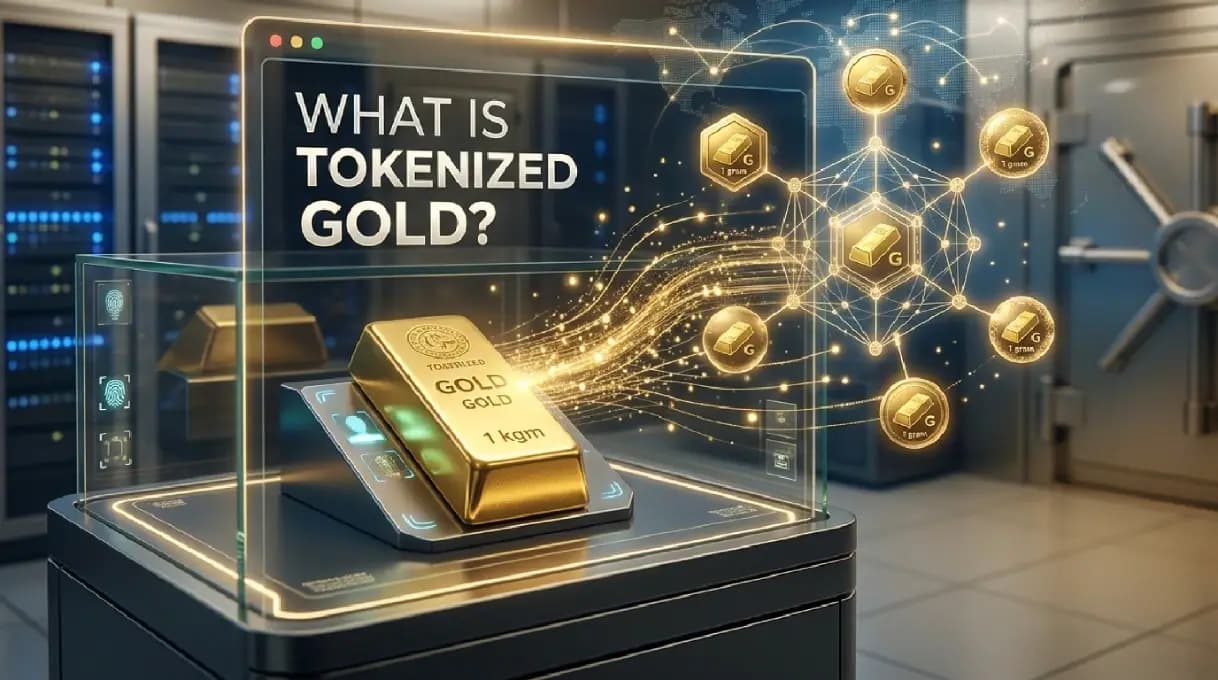
Quick answer: Tokenized gold is a digital token on a blockchain that gives you direct legal ownership of physical gold sitting in a professional vault. When you buy one token, you own a specific, weighed quantity of real metal, not a share in a fund, not a futures contract, not a promise. The token is your proof of ownership. It lives in your wallet, trades around the clock, and can be redeemed for the actual gold if you ever want it.